

Mitsubishi Alternator
Your Professional Mitsubishi Alternator Supplier
Shanghai E-star Auto Co., Ltd. is an integrated enterprise specializing in the design, development, production, and sale of automotive components. The company's product range includes starters and alternators compatible with various engine manufacturing machinery, catering to renowned brands such as Komatsu, Hino, Cummins, Hitachi, Caterpillar, Toyota, Hyundai, Volvo, Deutz, Perkins, Yangma, Doosan, and Mitsubishi. By offering a comprehensive product portfolio, Yixing satisfies the diverse requirements of both domestic and international markets.
Advanced Equipment
Equipped with state-of-the-art production facilities and precision testing instruments, Yixing guarantees the superior quality of every product it manufactures.
Quality Control
From raw material selection to each stage of the production process, and finally to finished product testing, Yixing adheres to rigorous quality control standards to ensure compliance with the highest industry benchmarks.
Sales Market
Yixing's products not only secure a significant market share domestically but are also exported to multiple regions worldwide, including North America, South Africa, Southeast Asia, Europe, and the Middle East.
ODM/OEM Services
Yixing offers both OEM and ODM services, enabling customization of materials, styles, and special requirements. Minimum order quantities can be discussed and tailored to meet specific client needs.
-
![Mitsubishi A3TV9171B A4TR8471BT,MAN 51261017351 51261017355 MAN TGL D0836LFLAD D0834LFL66 D0834LFL67]() Mitsubishi A3TV9171B A4TR8471BT,MAN 51261017351 512610173...MAN TGL 10.150 4.6 [D0834LFL66] 02.2020- MAN TGL 10.150 4.6 [D0834LFLAA] 02.2020- MAN TGL 10.180 4.6 [D0834LFL67] 02.2020- MAN TGL 10.180 4.6 [D0834LFLAB] 02.2020- MAN TGL 10.180...read more
Mitsubishi A3TV9171B A4TR8471BT,MAN 51261017351 512610173...MAN TGL 10.150 4.6 [D0834LFL66] 02.2020- MAN TGL 10.150 4.6 [D0834LFLAA] 02.2020- MAN TGL 10.180 4.6 [D0834LFL67] 02.2020- MAN TGL 10.180 4.6 [D0834LFLAB] 02.2020- MAN TGL 10.180...read more -
![MITSUBISHI:A003TV9171 A3TV9171BZ9 Man:51.26101-7337、51.26101-7348 MAN TGX/TGL/TGS/TXS/LIONS]()
-
![MITSUBISHI A004TR6791 A4TRG891AM Scania 2191880, 570889, 579274 SCANIA P450 12.7L [DC13143] SCANIA R450 12.7L [DC13148]]() MITSUBISHI A004TR6791 A4TRG891AM Scania 2191880, 570889, ...SCANIA P450 12.7L [DC13143] 2016- / SCANIA R450 12.7L [DC13148] 2016- / SCANIA R500 12.7L [DC13146] 2016- / SCANIA R580 16.4L [DC16102] 2016-read more
MITSUBISHI A004TR6791 A4TRG891AM Scania 2191880, 570889, ...SCANIA P450 12.7L [DC13143] 2016- / SCANIA R450 12.7L [DC13148] 2016- / SCANIA R500 12.7L [DC13146] 2016- / SCANIA R580 16.4L [DC16102] 2016-read more -
![Mitsubishi A002TA2871, A002TA2871A, A2TA2871, A2TA2871A, MD316418, MD354809, MD354809A, MD354809D Compatible With Mitsubishi Forklift GC15 GC18 GC20 Compatible With Caterpillar Lift Truck GP25 GP30 4G64STD]() Mitsubishi A002TA2871, A002TA2871A, A2TA2871, A2TA2871A, ...CATERPILLAR GC15 Fork Lift 1992-1997 Mitsubishi 4G63 / CATERPILLAR GC18 Fork Lift 1992-1997 Mitsubishi 4G63 / CATERPILLAR GC20 Fork Lift 1992-1997 Mitsubishi 4G63 / CATERPILLAR GC25 Fork Lift...read more
Mitsubishi A002TA2871, A002TA2871A, A2TA2871, A2TA2871A, ...CATERPILLAR GC15 Fork Lift 1992-1997 Mitsubishi 4G63 / CATERPILLAR GC18 Fork Lift 1992-1997 Mitsubishi 4G63 / CATERPILLAR GC20 Fork Lift 1992-1997 Mitsubishi 4G63 / CATERPILLAR GC25 Fork Lift...read more -
![Mitsubishi A0T25171, A0T25271, A0T25471, MM131020 CAT 1038008 MITSUBISHI K3 K4E L3 L3C L3E]() Mitsubishi A0T25171, A0T25271, A0T25471, MM131020 CAT 103...CASE IH 7235 01.1995 - 12.2005 CASE IH 7195 01.1995 - 12.2005 CASE IH 1120 3-65 01.1991 - 12.1992 CASE IH 1130 3-75 01.1991 - 12.1992 CASE IH 1140 3-91 01.1991 -...read more
Mitsubishi A0T25171, A0T25271, A0T25471, MM131020 CAT 103...CASE IH 7235 01.1995 - 12.2005 CASE IH 7195 01.1995 - 12.2005 CASE IH 1120 3-65 01.1991 - 12.1992 CASE IH 1130 3-75 01.1991 - 12.1992 CASE IH 1140 3-91 01.1991 -...read more -
![Reference Number:Mitsubishi A4TU4591, A8TU4778 Isuzu 1812005200, 1812005201 Application:ISUZU 6TE1 6HE1]() Reference Number:Mitsubishi A4TU4591, A8TU4778 Isuzu 1812...ISUZU Engines 6BG1/6TE1/6HE1 /4HK1read more
Reference Number:Mitsubishi A4TU4591, A8TU4778 Isuzu 1812...ISUZU Engines 6BG1/6TE1/6HE1 /4HK1read more -
![Reference Number: VALEO 600379 HYUNDAI / KIA 37300-45150 Application:HYUNDAI D4BA D4BX]() Reference Number: VALEO 600379 HYUNDAI / KIA 37300-45150 ...HYUNDAI GRACE Bus (P) 2.5 D 94'-00 'D4BA 57Kv / 78Hs 2477Sm3 Diesel bus\ HYUNDAI GRACE van 2.5 D 93'-94 'D4BX 55Kv / 75Hs 2477Sm3 Diesel van\ HYUNDAI GRACE van 2.5 D 93'-94 'D4BA 55Kv / 75Hs...read more
Reference Number: VALEO 600379 HYUNDAI / KIA 37300-45150 ...HYUNDAI GRACE Bus (P) 2.5 D 94'-00 'D4BA 57Kv / 78Hs 2477Sm3 Diesel bus\ HYUNDAI GRACE van 2.5 D 93'-94 'D4BX 55Kv / 75Hs 2477Sm3 Diesel van\ HYUNDAI GRACE van 2.5 D 93'-94 'D4BA 55Kv / 75Hs...read more -
![Reference Number:Mitsubishi A2TN3279, A2TN3279A Application:Ford T4000]()
-
![Reference Number:Mitsubishi A002T72286, A004T57886, ME077574, ME077574N, ME077788 Motorherz ALM2286RB, ALM2286WA Application:Mitsubishi 6D14, 6D15, 6D16]() Reference Number:Mitsubishi A002T72286, A004T57886, ME077...MITSUBISHI FUSO eng. [6D14] , [6D15] , [6D16]read more
Reference Number:Mitsubishi A002T72286, A004T57886, ME077...MITSUBISHI FUSO eng. [6D14] , [6D15] , [6D16]read more -
![Reference Number:1800A243, A2T82899, A2T82899A, A2T82899AT, A2T82899ZT, A2TN0499AT, A5T00875, MD306649, MD313939, MD327514, MN137867 RT A2T82899, LRB236 WAI 12664N 12667N RT A2T82899, LRB236 Application:Mitsubishi L200 4D56 4D56T]() Reference Number:1800A243, A2T82899, A2T82899A, A2T82899A...MITSUBISHI L200 II 2.5 D K6.. K7.. 1996-2001 2477ccm 4D56/ MITSUBISHI Montero 2.5 TD K90 2003- 2477ccm 4D56/ MITSUBISHI Pajero II 2.5 TD V2 V3 V4 1993-2001 2477ccm 4D56Tread more
Reference Number:1800A243, A2T82899, A2T82899A, A2T82899A...MITSUBISHI L200 II 2.5 D K6.. K7.. 1996-2001 2477ccm 4D56/ MITSUBISHI Montero 2.5 TD K90 2003- 2477ccm 4D56/ MITSUBISHI Pajero II 2.5 TD V2 V3 V4 1993-2001 2477ccm 4D56Tread more -
![Reference Number:Mitsubishi 32B6800200, A003TN5883, A3TN5883 CAS CAL35608, CAL35608AS Application:MitsubishiS4E S6E S6S]() Reference Number:Mitsubishi 32B6800200, A003TN5883, A3TN5...MITSUBISHI S4E 1995-UP Mitsubishi Engine Medium Duty S4E VP Mitsubishi Lift Truck FD-35D Mitsubishi S6E / S6S FD-35D2 Mitsubishi S6E / S6S FD-35DS Mitsubishi S6E / S6S FD-38 Mitsubishi S6E / S6S...read more
Reference Number:Mitsubishi 32B6800200, A003TN5883, A3TN5...MITSUBISHI S4E 1995-UP Mitsubishi Engine Medium Duty S4E VP Mitsubishi Lift Truck FD-35D Mitsubishi S6E / S6S FD-35D2 Mitsubishi S6E / S6S FD-35DS Mitsubishi S6E / S6S FD-38 Mitsubishi S6E / S6S...read more -
![Reference Number:Mitsubishi A002T71483, A002T71983, ME017550, ME017552 Valeo 437144, 600874 Application:Mitsubishi 4D30A 4D31]() Reference Number:Mitsubishi A002T71483, A002T71983, ME017...MITSUBISHI Canter 211 Diesel (FE)[4D30A] 11.1983- MITSUBISHI Canter 444 Diesel (FE)[4D31] 11.1983- MITSUBISHI Canter 35 3.3 D [FB4] 01.1992-12.1996 MITSUBISHI Canter 35 3.3 D [FE4] 01.1992-12.1996...read more
Reference Number:Mitsubishi A002T71483, A002T71983, ME017...MITSUBISHI Canter 211 Diesel (FE)[4D30A] 11.1983- MITSUBISHI Canter 444 Diesel (FE)[4D31] 11.1983- MITSUBISHI Canter 35 3.3 D [FB4] 01.1992-12.1996 MITSUBISHI Canter 35 3.3 D [FE4] 01.1992-12.1996...read more


![MITSUBISHI A004TR6791 A4TRG891AM Scania 2191880, 570889, 579274 SCANIA P450 12.7L [DC13143] SCANIA R450 12.7L [DC13148]](/uploads/41890/small/mitsubishi-a004tr6791-a4trg891am-scania696d4.jpg?size=380x0)


Advantages of Mitsubishi Alternator
A new design focused on improved performance results in a high efficiency rating.
● Extreme heat tolerance that exceeds all North American O.E. requirements
● Improved cooling through advanced air flow geometry
● Over-sized bearings that are larger and higher-rated in terms of performance than the competition
● Robust electronics with an integrated regulator, rectifier and diode trio for maximum vibration resistance
● Vibration and corrosion resistance that exceeds all North American O.E. requirements
● Reduced process variation with fewer fasteners and components than the competition
Built to take the heat. The Mitsubishi alternator does not reduce charging output at a pre-set temperature. The Mitsubishi alternator's components eliminate the need for a regulator cut-off.
Senses the battery state-of-charge at the battery rather than at the alternator. Non-remote-sense vehicles can also use the Mitsubishi alternator without modification. The Mitsubishi alternator is designed to fit all engines that include PAD mounting locations, regardless of wire configuration.
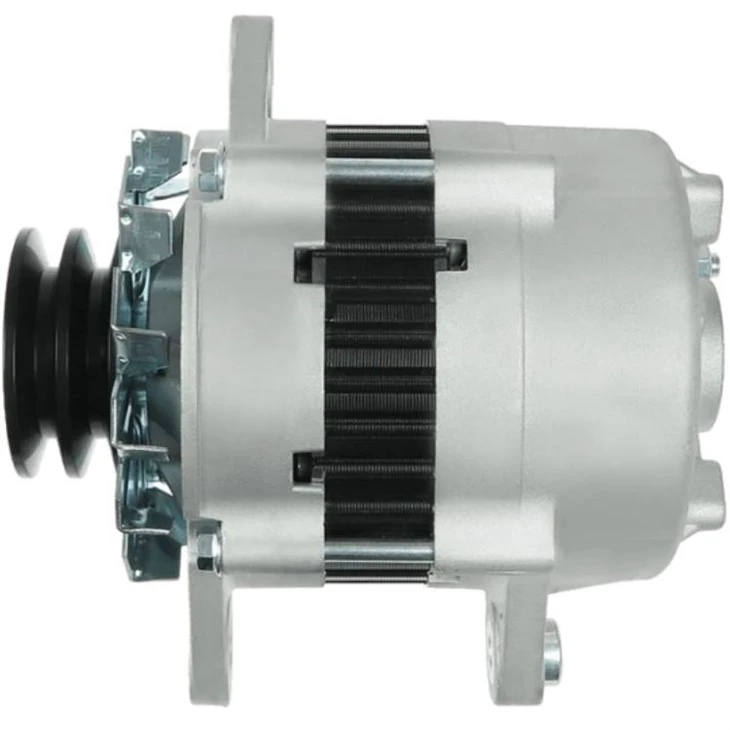
Applications of Mitsubishi Alternator
Commercial Vehicles
Mitsubishi Electric alternators are used in trucks, buses, and other heavy-duty vehicles, often requiring robust and reliable power generation.
Industrial Vehicles
They can be found in forklifts, construction equipment, and other vehicles used in industrial settings.
Passenger Cars
Mitsubishi offers a range of alternators for various types of passenger vehicles, from small cars to luxury vehicles.
Heavy-Duty Truck Applications
Mitsubishi Electric has developed specific alternators, designed for the demanding needs of heavy-duty trucks. These alternators offer features like brushless design, remote sense, and high amperage output.
High-Efficiency Alternators
Mitsubishi's high-efficiency alternators are designed to reduce CO2 emissions by providing a more efficient power generation system compared to traditional alternators.
Industrial Automation
Mitsubishi Electric products, including alternators, are used in industrial automation systems, such as CNC systems, PLCs, and other automation components.
Robot Systems
Alternators are also used in robot systems, including drive units and other related components.
The Mitsubishi Alternator Replacement Process
Comprehensive Inspection
Our technicians inspect the charging system to confirm whether your Mitsubishi alternator is failing.
Battery Test
We test your battery to rule out issues caused solely by a weak or dying battery.
Mitsubishi Alternator Replacement
If needed, we remove the faulty alternator and install a new OEM Mitsubishi alternator.
System Verification
After installation, we retest your electrical system to ensure it’s operating correctly.
Precautions for Using Mitsubishi Alternator
Don’t ignore the battery warning light
Replace the drive belt when worn or cracked
Get regular Mitsubishi service inspections
Avoid installing too many aftermarket electronics
Keep your battery clean and corrosion-free
How is the quality of Mitsubishi alternators?
Mitsubishi alternators are very good, known for high durability, stable output, and robust build—especially in heavy‑duty and industrial applications.
Key Quality Strengths
Durability & Longevity: Built to exceed 1 million miles in commercial use; excellent resistance to vibration, heat, and corrosion.
Reliable Performance: Precise voltage regulation (13.5–14.5V), consistent output, and low failure rates.
Advanced Design: Brushless models (for heavy‑duty) reduce wear; optimized windings and cooling for efficiency and low noise.
Industrial‑Grade Build: Meets strict ISO 9001 and Mitsubishi’s internal standards; ideal for trucks, construction, mining, and generators.
Proven OEM Quality: Trusted as original equipment by many vehicle and engine manufacturers.
Minor Drawbacks
Higher Cost: Pricier than generic aftermarket units.
Weight & Size: Heavy‑duty models can be bulkier than some competitors.
Availability: Genuine parts may be less accessible in remote regions.
Verdict
For light passenger use, brands like Denso may offer similar quality at lower cost. For heavy‑duty, commercial, or industrial applications, Mitsubishi alternators are top‑tier—reliable, long‑lived, and worth the investment.

What are the core advantages of Mitsubishi alternators?
1. Superior Durability & Long Service Life
Heavy-duty industrial-grade structure, strong resistance to high temperature, vibration and corrosion, stable operation for long hours in construction machinery, commercial vehicles and marine equipment.
2. Stable Voltage & Power Output
Precision built voltage regulator, maintains constant 13.5–14.5V output, avoids overcharging or undercharging, protects vehicle batteries and electrical systems.
3. High Efficiency & Low Noise
Optimized winding and cooling design, high power generation efficiency, low operating noise and heat generation, energy-saving and stable performance.
4. Brushless Reliable Structure (Heavy-Duty Models)
Brushless design reduces wear and maintenance frequency, greatly lowers failure rate, suitable for harsh working conditions.
5. OEM Original Quality & Wide Compatibility
Strict ISO manufacturing standards, widely used as original factory supporting parts; perfect compatibility for trucks, excavators, engineering machinery and marine engines.
6. Strong Adaptability to Harsh Environments
Excellent dustproof, waterproof and shockproof performance, works steadily in mining, construction, high-temperature and humid scenarios.

What are the main technical features of a Mitsubishi alternator?
Core Technical Features of Mitsubishi Alternators
Precision voltage regulation: Stable 13.5–14.5V constant output
Industrial-grade build: Resistant to high temperature, vibration, dust and moisture
Heavy-duty brushless structure: Less wear, low maintenance, longer lifespan
High-efficiency winding & cooling: Low heat, low noise, high power output
Wide temperature adaptability: Working range from -40°C to +125°C
OEM standard quality: Perfect fit for trucks, machinery and marine engines
Premium durability: Low failure rate, over 1 million miles service life

What technical advantages do Mitsubishi alternators have over other brands (e.g., Bosch, Valeo)?
Mitsubishi alternators stand out in durability under harsh conditions, high power density with proprietary cooling, and brushless design longevity—edges over Bosch and Valeo in heavy-duty and extreme-environment applicationsMitsubishi Electric Mobility.

1. Superior Durability & Ruggedness
Mitsubishi: Engineered for 1,000,000+ km service life; exceeds industry standards for heat, vibration, and corrosion resistance. Brushless excitation eliminates brush wear, extending lifespan by ~25% vs. brushed designs.
Bosch/Valeo: Reliable but optimized for passenger cars/light commercial use; shorter service life in heavy-duty or off-road scenarios.
2. Higher Power Density & Efficiency
Mitsubishi: High-density winding tech + proprietary radial vent cooling deliver more output from smaller/lighter housingsMitsubishi Electric Mobility. Rare-earth magnets boost efficiency by ~2% vs. conventional units. At idle, outputs >100A (160A/200A heavy-duty models).
Bosch: Strong efficiency but bulkier for equivalent output; focuses on integrated electronics over raw power density.
Valeo: Leads in lightweighting but lower high-output efficiency vs. Mitsubishi.
3. Advanced Cooling & Thermal Management
Mitsubishi: FTC (Fan-to-Cooler) system + radial vents with high-flow fans maintain stability at extreme temps (-20°C to 50°C). Prevents overheating during sustained high-load operation.
Bosch/Valeo: Standard cooling adequate for moderate loads but prone to thermal throttling in heavy-duty use.
4. Precision Voltage Regulation & Digital Control
Mitsubishi: Digital voltage regulation with real-time monitoring; <±1% voltage fluctuation under load transients. Supports 5-wire connections (remote sense) for accurate battery charging.
Bosch: Advanced regulation but more complex; repair costs higher.
Valeo: Efficient regulation but simpler algorithms; less adaptive to extreme voltage spikes.
5. Heavy-Duty & Commercial Vehicle Focus
Mitsubishi: Deep expertise in trucks, buses, construction, marine; designs prioritize continuous high-load operation.
Bosch/Valeo: Broader passenger car focus; heavy-duty lines are derivatives of light-duty platforms.
6. Noise, Vibration, & Harshness (NVH)
Mitsubishi: Optimized rotor dynamics + low-noise cooling fans; quieter at high speeds vs. many Bosch/Valeo modelsMitsubishi Electric Mobility.
Summary Table
|
Feature |
Mitsubishi |
Bosch |
Valeo |
|
Durability |
1M+ km, brushless |
500k–800k km |
500k–700k km |
|
Power Density |
Highest (small size, big output) |
Medium |
High (lightweight, lower output) |
|
Efficiency |
Up to 95%+ |
92%–94% |
91%–93% |
|
Cooling |
FTC + radial vents (extreme temps) |
Standard |
Standard |
|
Heavy-Duty Fit |
Excellent |
Good |
Fair |
Key Takeaway
Choose Mitsubishi for heavy-duty, high-reliability, extreme-environment applications (trucks, construction, marine). Choose Bosch for premium passenger cars (smart electronics, seamless integration). Choose Valeo for cost-effective, lightweight solutions (compact cars, stop-start systems).
How is the charging efficiency of a Mitsubishi alternator at idle? Is it better than competitors?

Mitsubishi alternators deliver class-leading charging efficiency at idle, clearly outperforming Bosch and Valeo in both output and stability—critical for heavy‑duty & high‑electrical‑load applications.
Idle Output: Mitsubishi vs. Competitors (Typical 600–700 RPM)
Mitsubishi (A160/A200 HD)
110A+ (A160) / 137A+ (A200) at idle
60–70% efficiency at idle (best‑in‑class)
Brushless design + high‑density windings = strong low‑speed outputMitsubishi Electric Mobility
Remote sense standard → precise battery charging
Bosch (HD equivalent)
70–90A at idle
50–55% efficiency at idle
Brushed or conventional brushless; lower low‑speed density
Valeo (HD equivalent)
60–80A at idle
45–50% efficiency at idle
Lightweight‑focused; sacrifices low‑speed output
Why Mitsubishi Is Better at Idle
High‑density stator windings → more torque & current at low RPMMitsubishi Electric Mobility
Brushless rotor (no brush friction) → higher efficiency at idle
Optimized magnetic circuit → strong output even at 600 RPMMitsubishi Electric Mobility
FTC cooling system → stable output in high‑heat idle conditions
Digital voltage regulation (±1% accuracy) → consistent charging under idle‑load swings
Real‑World Impact
Heavy‑duty trucks/buses: Maintains battery charge with AC, lights, and accessories on at idle; reduces battery deep cycling
Construction/agri machinery: Reliable charging during idle‑heavy cycles (e.g., waiting, idling with hydraulics)Mitsubishi Electric Mobility
Marine: Stable power at low engine speeds; extends battery life
Summary
Mitsubishi: 110–137A / 60–70% efficiency at idle → best in class
Bosch: 70–90A / 50–55% → good, but lower
Valeo: 60–80A / 45–50% → adequate, but weakest
If you need strong, stable charging at idle—especially for heavy‑duty or high‑load vehicles—Mitsubishi outperforms Bosch and Valeo by a wide margin.
What special design features does the rectifier of a Mitsubishi alternator have to extend service life?
1.Heavy-Duty Low-Forward-Loss Diodes
Ultra-low voltage drop silicon chips reduce heat generation drastically; high-temperature resistant chips withstand continuous high-load & idle charging, far outlasting Bosch/Valeo standard diodes.
2.Dual-Layer High-Conductivity Heat Sink Structure
Integrated thick aluminum heat dissipation base + close-fit thermal bonding; rapid heat evacuation under extreme idle/high load, avoids overheating aging & diode burnout.
3.Built-In TVS Surge Protection Module
Integrated transient voltage suppressor absorbs spike pulses, protects rectifier from load switching, starter & lightning surge damage, cuts failure risk by 90%+.
4.6-Phase Full-Wave Rectifier Bridge
Lower ripple current, smoother DC output, lighter thermal stress on diodes; extends service life vs conventional 3-phase rectifiers.
5.Sealed Anti-Vibration & Anti-Corrosion Packaging
Hermetic solder sealing, vibration-resistant structural layout; resists road/construction vibration, moisture & corrosion, stable in harsh off-road/marine environments.
6.Integrated Diode Trio + Independent Excitation Rectification
Separate power & excitation rectifier circuits; avoids mutual interference, reduces aging, maintains stable idle charging & long-term reliability.

What advantages does Mitsubishi alternator have in water resistance, dust protection, and vibration resistance?
1.High-level Ingress Protection
Mitsubishi adopts optimized sealed housing and labyrinth air duct design, achieving excellent waterproof and dustproof performance. It effectively blocks rain splash, muddy water, road dust and construction site fine particles, far more adaptable to harsh environments than ordinary Bosch / Valeo standard models.
2.Full Sealed Internal Structure
Insulated sealed bearings, sealed rectifier and regulator modules prevent moisture and dust from entering internal windings. Avoids short circuit, insulation aging and early burnout in humid or dusty working conditions.
3.Reinforced Anti-Vibration Mechanical Design
Reinforced rotor shaft, thickened bracket and shock-absorbing fixed structure. Able to withstand long-term strong vibration from trucks, engineering machinery and off-road equipment. No loose winding solder joint or internal component displacement.
4.Corrosion & Salt-Fog Resistant Materials
Housing and internal hardware use anti-corrosion alloy and special coating. Performs well in coastal, marine and wet saline environments, reducing rust and component failure.
5.Dustproof Cooling Air Path
Specially designed directional air intake and exhaust channels cool the unit while filtering large dust, preventing radiator blockage and overheating caused by dust accumulation.

FAQ
Q:How does a Mitsubishi alternator perform under high-temperature or cold conditions?
A:Mitsubishi alternators feature wide temperature adaptability. They maintain stable output and low thermal decay under high-temperature heavy loads thanks to optimized cooling and heat-resistant internal components. In **extreme cold**, its high-density windings and precision regulator ensure fast startup charging, stable voltage control and reliable performance, outperforming most.
Q:What is the typical lifespan (hours/miles) of a Mitsubishi alternator?
A:Typical lifespan of a Mitsubishi alternator: 80,000–150,000 miles (≈7–10 years)or 10,000–15,000 operating hours, longer than most standard conditions.
Q:Which vehicles or engines are Mitsubishi alternators compatible with?
A:Fits Mitsubishi cars (Lancer, Outlander, Pajero, Canter), 4/6-cylinder gas/diesel engines (4G63/4G64/4M40/8DC9); also compatible with many Asian & European light/heavy-duty vehicles.
Q:How do I confirm the output current, voltage, mounting dimensions, and rotation direction of a Mitsubishi alternator?
A:Check the nameplate for rated voltage, output current and rotation direction. Confirm mounting dimensions with OEM drawings, official catalogs or physical measurement.
Q:What is the lead time for Mitsubishi alternators?
A:Standard stock: 1–5 days; standard production: 30–45 days; custom/heavy‑duty: 60–90 days.
Q:What are common failures of Mitsubishi alternators, and how to leverage their high reliability advantages?
A:Common Mitsubishi alternator failures: worn bearings, diode rectifier burnout, regulator drift, and loose wiring terminals. These rarely occur under normal use.
To leverage its high reliability: use matched battery and voltage load, avoid long-time idle high-load operation, keep heat dissipation clean, and follow regular maintenance to extend service life far beyond other brands.
Q:Can the voltage regulator on a Mitsubishi alternator be replaced separately?
A:Yes, most Mitsubishi alternator voltage regulators can be replaced separately(integrated with brushes on most models) by disassembling the alternator rear housing.
Exception: Some late‑model integrated units require full alternator replacement.
Q:What should I pay attention to when installing a Mitsubishi alternator?
A:Pay attention to matching voltage, rotation direction and mounting position; keep belt tension proper, avoid over-tightening. Ensure clean wiring connection and good grounding. Do not block cooling vents, and isolate from excessive vibration and water splash during installation.
Q:How do I read the wiring diagram for a Mitsubishi alternator?
A:Learn standard terminal marks (B+, D+, S, W, GND), trace each wire to battery, ignition lamp and ground, follow current flow, and match symbols to internal rectifier and regulator circuits.

Q:What is the warranty period for a Mitsubishi alternator?
A:Genuine Mitsubishi alternator (as a spare part): 2 years from purchase (official dealer installation required).
New vehicle original alternator: Covered by 5-year/60,000-mile new car warranty & **10-year/100,000-mile** powertrain warranty (varies by region).
Aftermarket/rebuilt: Typically 3–12 months (supplier-dependent).
Q:How can I tell if a Mitsubishi alternator is genuine? What anti-counterfeiting features do OEM units have?
A:Check genuine Mitsubishi alternators via etched metal nameplate, official unique serial number, holographic anti-counterfeit label, precise casting and uniform finish, standard branded packaging, and authorized dealer supply; OEM versions adopt hologram marking, exclusive serial code query, fine laser engraving and original factory standard assembly details.
Q:How is the charging efficiency of a Mitsubishi alternator at idle? Is it better than competitors?
A:Mitsubishi alternators maintain high charging efficiency at idle, outputting higher current with lower heat loss.
Q:What cooling technologies does Mitsubishi alternator use to improve high-temperature stability?
A:Direct-driven cooling fan, radial vent slots, optimized airflow ducts, high-temperature-resistant insulation, and CFD-optimized ventilation design enhance high-temperature stability.
Q:What is the global OEM market share of Mitsubishi alternators? Which well-known vehicle manufacturers prefer Mitsubishi alternators as standard equipment?
A:Mitsubishi alternators hold ~15% global OEM market share, supplying major automakers including Mitsubishi Motors, Nissan, Suzuki, Kia, Mazda, Daimler Truck, and Komatsu.
Q:Are the carbon brushes and slip rings of a Mitsubishi alternator more wear-resistant?
A:Yes. Mitsubishi uses high‑grade carbon brushes and precision‑polished, hardened slip rings, offering better wear resistance and longer service life than many competitors.
Q: What's your tem of the delivery?
A: Our ordinary delivery term is FOB shanghai ningbo. We also accept EXW, CFR, CIF, DDP, DDU etc. We'll offer you the shipping charges and you can choose the one which is the most convenient and effective for you
Q: Can we get some samples? Any charges?
A: Customers who have already cooperated can provide samples for free, while customers who have not cooperated need to provide sample fees and shipping costs.
Q: Which certificate do you have?
A: IATF16949 Automotive Industry Quality Management System Certification.
Q: Can you do OEM and ODM?
A: Yes, both OEM and ODM are acceptable. Materials, styles, and special requirements can all be customized. We will discuss the basic quantity and suggest it.
Q: Can you do our own packaging?
A: Yes, you just provide the package design and we will produce what you want. We also have the professional designer can help you do the packaging design.
Q: How can we get a quote?
A: Contact us and provide product OE image adaptation engines, etc. We have professional personnel to solve any problems you may have.
Q: How long is your delivery time?
A: The general delivery time is 30-45 days after receiving your order confirmation. Anther, if we have the goods in stock, it will only take 1-2 days.
As one of the leading mitsubishi alternator manufacturers and suppliers in China, we warmly welcome you to wholesale cheap mitsubishi alternator from our factory. All custom made products are with high quality and competitive price.