

When ordering a replacement starter motor, skipping specification checks often leads to wrong parts, machine downtime and extra costs. Many buyers only compare appearance, which is not reliable. Below we list all critical starter motor specifications you must verify before purchasing your replacement starter.
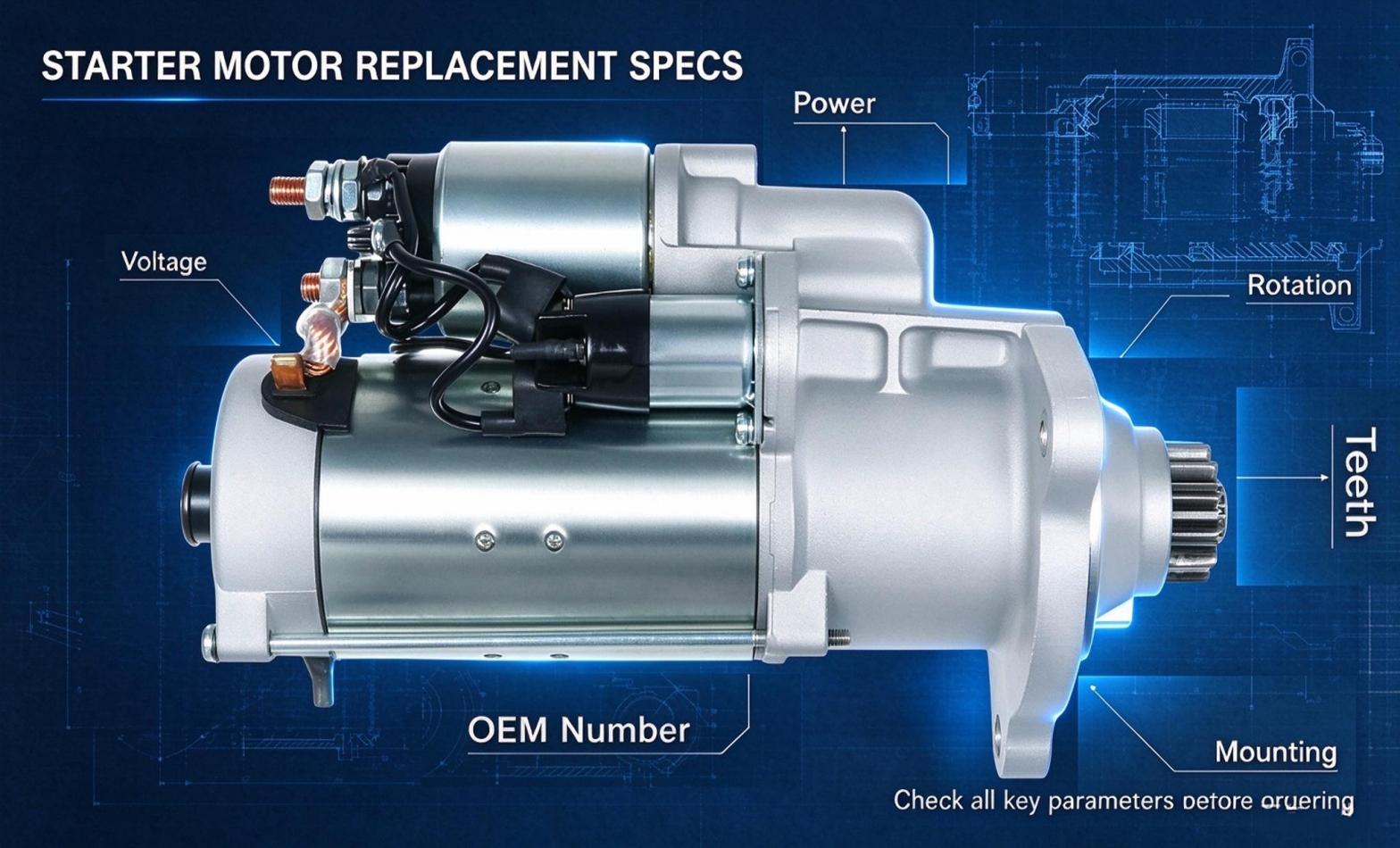
7 Core Specifications to Verify
Voltage Confirm 12V or 24V. Mismatched voltage will fail cranking or burn the starter coil immediately.
Power Power rating defines cranking torque. Diesel engines require higher power output than gasoline engines.
Pinion Gear Teeth The number of pinion teeth must match the flywheel ring gear. Wrong teeth cause grinding noise, gear damage or failed engagement.
Rotation Direction Clockwise (CW) or Counter-clockwise (CCW). Rotation direction is determined by engine design; cannot be modified after production.
OEM Number OEM part number is the most accurate cross-reference for fast and correct part matching.
Mounting Dimensions Check flange type, mounting hole position & hole spacing. Even if other specs match, wrong mounting prevents installation.
Application Confirm the exact engine or equipment model the starter fits, to avoid mismatch for special machinery.
Important Tip: All parameters must match together. A part can have the correct OEM number but wrong rotation or teeth, making it unusable.
FAQ
Q: Can I adjust rotation direction if it does not match my engine?
A: No. The rotation is fixed by internal motor structure. You have to select a replacement starter motor with correct rotation.
Q: Is OEM number enough for matching a replacement starter?
A: OEM number is the best reference, but you still need to double-check mounting, teeth and rotation for special equipment.
👉 Browse our full range: Starter Motor category & individual product pages